At a glance
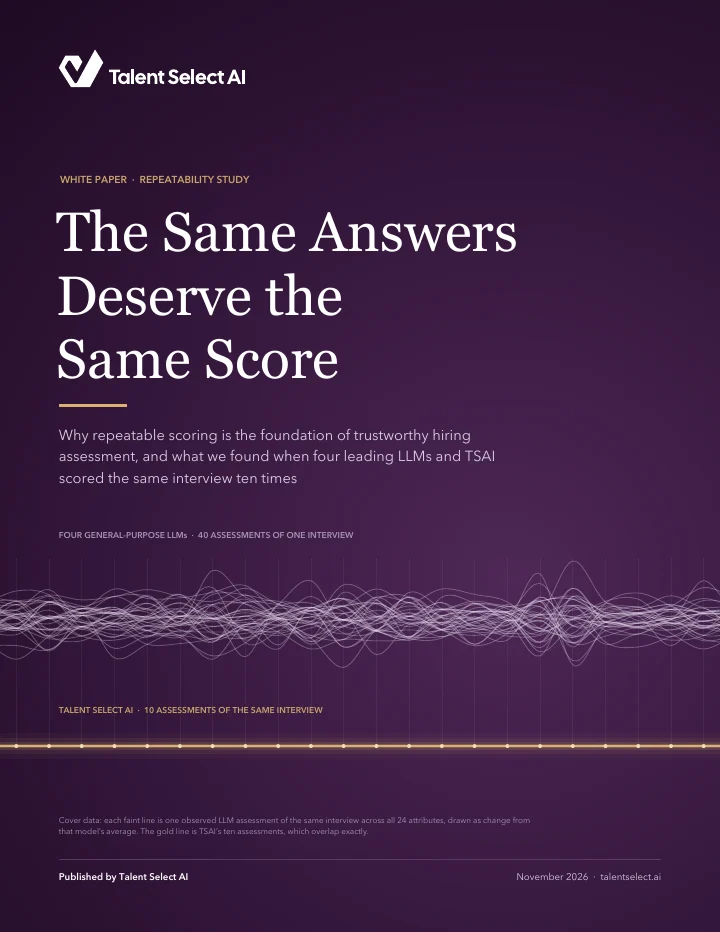
A hiring score should describe the candidate, not the run that produced it. In a controlled pilot, the TSAI V1 API returned identical scores on all 24 attributes across ten assessments of one fictional interview. GPT 6.2 Sol, Claude Opus 5.5, Gemini 4 Neon, and Grok 4.7 each returned ten different score profiles from the same answers.
Why does repeatable scoring matter in hiring?
A hiring assessment is a measurement, and a measurement is only useful if it gives the same reading when nothing has changed. Measurement science calls this reliability. Variation from one run to the next is error, and error limits how closely any score can reflect the person being measured.
In hiring, that variation has practical consequences. Candidates who give the same answers should receive the same score. When a workflow turns scores into advance, hold, or decline decisions, variation that crosses a cutoff changes the outcome. And when a candidate, manager, or auditor asks how a decision was reached, the team needs a result it can reproduce.
Why can LLM ratings change from run to run?
General-purpose large language models generate each response by sampling from probabilities, and their default settings include randomness. The same prompt can therefore return a different answer each time. That variety is useful in writing; in scoring a candidate, it becomes a hidden variable.
The variation is also easy to miss. In everyday use, each candidate is scored once, so no one sees the different score a second run might have produced.
How was the study designed?
The study held one input fixed: a fictional candidate answering eight common interview questions in 1,337 words. Every system rated the same 24 TSAI attributes, and the LLMs received the full definition of each one. GPT 6.2 Sol, Claude Opus 5.5, Gemini 4 Neon, and Grok 4.7 were each run ten times through OpenRouter, in a fresh context with response caching disabled. The TSAI V1 API was run ten times on the same text.
- Exact repeat: all 24 scores match between two runs.
- Range: the highest minus the lowest score for an attribute across ten runs.
- Every valid result was retained, including one documented replacement for a rate-limited request.
What did the results show?
TSAI returned the same 24 scores in all ten assessments. None of the 180 within-model pairs of LLM runs produced an identical 24-score profile, and each LLM changed at least 16 of its 24 scores between its first and second runs. The average difference between two LLM runs was 1.88 to 2.80 points on a 1 to 100 scale, but individual attributes moved further: one model’s ratings for a single attribute ranged from 52 to 65.
The study shows a repeatability advantage for the tested TSAI endpoint. It does not establish that TSAI predicts job performance better or is fairer, and it does not show that every possible LLM configuration must vary. Repeatability is one requirement; job relevance, validity, and fairness need separate evidence.
Sources and further reading
This guide is adapted from Talent Select AI’s white paper. The pilot study it reports has not been peer reviewed. The sources below cover the measurement principles and LLM settings the paper discusses.
- SIOP (2018): Principles for the Validation and Use of Personnel Selection Procedures
- SIOP (2023): Considerations and Recommendations for the Validation and Use of AI-Based Assessments for Employee Selection
- OpenRouter: API parameters and sampling defaults
Download the complete paper for the full discussion and reference list.