At a glance
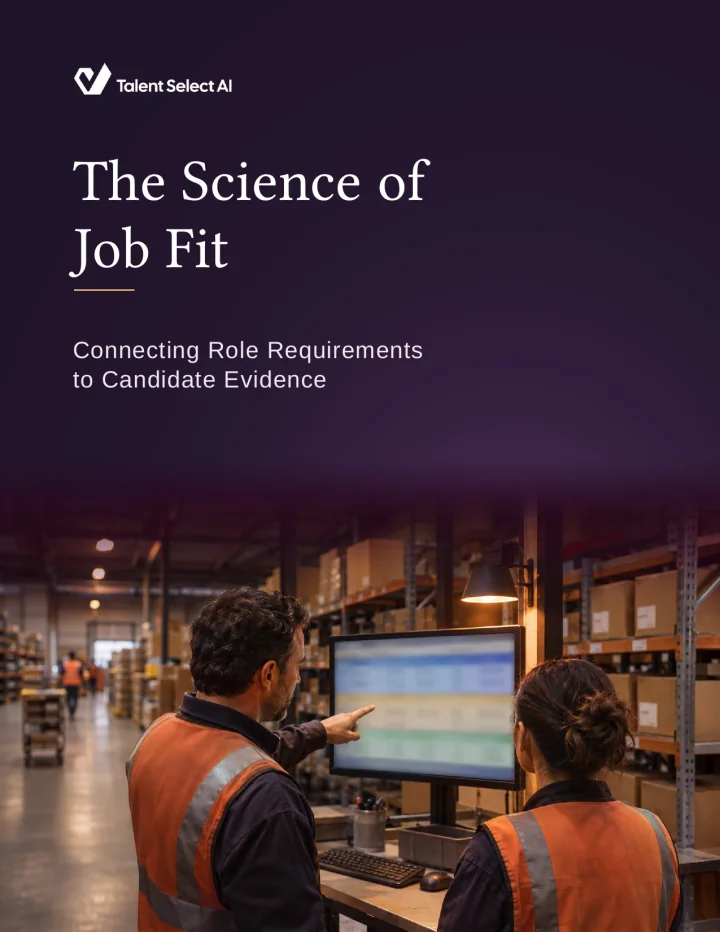
A job fit assessment should connect evidence about a candidate to the requirements of a particular role. Define the work first, ask questions that elicit relevant examples, and use an agreed evaluation standard. A Fit result should help reviewers interpret that evidence in context.
What does job fit mean in hiring?
In this guide, job fit means evidence of the capabilities the role requires. It is different from familiarity, shared interests, or whether an interviewer felt an easy connection. Replace a general impression with a specific question: which work requirement does this answer help us evaluate?
The same answer can matter differently for two jobs. A story about changing a team’s priorities may demonstrate coordination for a shift lead, while leaving an analyst’s technical requirements unanswered. That does not make the candidate universally strong or weak; the roles call for different evidence.
How does job analysis improve an assessment?
Start with the tasks, decisions, and conditions of the actual job. A job description and occupational information such as O*NET provide a starting point. Ask managers and people doing the work to confirm what matters at the site, what must be present at entry, and what can be learned after hire.
Translate broad labels into observable behavior. For example, replace “strong communicator” with an expectation such as explaining a change in priorities and confirming ownership of the next action. Confirm the profile before reviewing candidates and revisit it when the work changes.
How do you connect questions to job requirements?
Use a shared core of questions for candidates applying to the same role. Agree on neutral follow-ups about what the candidate personally did, the information available, and the outcome. Define the evidence that would support each rating before the interviews.
For a role that requires coordinating handoffs, an illustrative question is: “Describe a handoff you managed when work was still open. How did you make sure it got finished?” Review who owned the next action, what was communicated, and how the candidate checked the result. This is an example for interview design, not a Talent Select AI scoring key.
When the requirement is direct technical proficiency, a standardized work sample may provide evidence that an interview cannot. Choose the method for each requirement instead of expecting one interview to demonstrate everything.
How should a hiring team interpret a Fit result?
Talent Select AI uses job analysis informed by O*NET to identify three to seven critical traits. Candidate interview responses are assessed and related to the role, producing an Excellent, Strong, Average, or Low Fit result. The team should confirm that the profile represents the work and review the underlying evidence.
Fit is role-specific, not a general ranking of a person across unrelated jobs. Missing or unusable evidence also needs its own treatment. A short answer, an unasked question, or an incomplete transcript should prompt review rather than an unsupported conclusion about capability.
- Confirm the role profile and the evidence it requires.
- Review the result alongside the interview and other job-related evidence.
- Record the human decision and its rationale.
- Keep the relevant profile and assessment versions with the record.
Sources and further reading
This guide is adapted from Talent Select AI’s white paper. The research below examines the foundational methodology behind the assessment; Talent Select AI supported that research. It does not certify a product or establish suitability for every hiring use.
- Campion & Campion (2026), Journal of Applied Psychology
- EEOC: Employment Tests and Selection Procedures
Download the complete paper for the full discussion and reference list.